
Motivation
We assume Chapter 1's equations, functions, square roots, and domains. We now connect numbers with angles, periodic changes, and directed quantities. You will use radians consistently, solve elementary trigonometric equations without losing whole families of solutions, resolve vectors into components, and represent a pair of simultaneous equations in matrix form.
A scalar gives one magnitude, such as a temperature. A vector gives a directed quantity, such as a displacement. A periodic function describes a repeating pattern. None of these models is meaningful until its coordinate directions, units, and allowed inputs have been stated.
2.1 Radians and the unit circle
Definition
For a circle of radius , an angle in radians is the signed arc length divided by . A full turn is radians; radians. The definition makes radians dimensionless, although retaining the label “rad” helps distinguish an angle from another dimensionless quantity.
On the unit circle, the point reached after angle counterclockwise from the positive horizontal axis is . Thus
Both sine and cosine have period . Sine is odd and cosine is even: and . Define only when , so tangent is undefined at , .
Proposition
The angle-addition identities are
Proof
Take as a geometric fact that a rotation about the origin preserves distances and orientation and is linear in coordinate components. Let rotate counterclockwise through . On the unit circle, it sends the first and second coordinate basis vectors to
By linearity, its action on the point at angle is
Geometrically, successive rotations add their angles, so this same point is . Comparing coordinates proves both identities without assuming them. Setting gives and . An identity holds for every input in its domain; an equation asks which inputs make a particular equality true.
Worked example
Worked example 1: convert before calculating. A wheel of radius m turns through radians. The arc travelled is m. Substituting the degree number directly into would use the wrong angle unit.
2.2 Solving equations and choosing inverse branches
Proposition
If , the equation has repeating solutions. Let . All solutions are
Some parameterizations overlap at the extreme values , which causes repetition rather than extra solutions. For , there is no real solution.
Proof
Use the elementary geometry of the unit circle: every point has an angle, unique modulo , and the right semicircle has exactly one point at each height . Its coordinates are , and its angle in defines . A point with sine must satisfy , so its horizontal coordinate is either or its negative. The second point has angle modulo , by reflection across the vertical axis. These two points exhaust the horizontal line's intersections with the circle, proving both families and the absence of any others. At the two points coincide. At , is impossible over the reals. The same geometry gives the inverse branches for cosine on the upper semicircle and tangent on ; a ray in the right half-plane has slope , and each real slope determines exactly one such ray. Finally, only for , so any period of cosine, tested at angle zero, is an integer multiple of ; hence its least positive angular period is .
The function is the inverse of sine restricted to . It is not a global inverse of periodic sine. Likewise has values in , and in .
Worked example
Worked example 2: a bounded angular interval. Solve for . The angle lies in , so its possible values are , , , and . Dividing by two gives , , , . Returning only would miss three permitted solutions.
Common mistake
As another branch check, , not . The output must belong to the principal inverse's range.
2.3 Periodic models and phase
A model
has midpoint , amplitude , and period when and . The cosine angle argument must be dimensionless. If is in seconds, can be recorded in radians per second. The phase fixes where in the cycle the model starts.
Worked example
Worked example 3: combine two quadrature components. Consider
Choose with , . The addition identity gives
The amplitude is , the period is time units, and the first maximum for occurs at . A graphing calculator can illustrate the pattern, but the identity proves its amplitude and phase exactly.
Common mistake
The sum of two periodic signals need not have the same period as either, and if their periods have an irrational ratio there may be no common nonzero period. Do not assume that any sum of oscillatory terms automatically repeats over one convenient interval.
2.4 Vectors and components
Optional: vector bridge. Rectangular components and angle checks support coordinates; vector resultants, dot products and projections prepare for later linear algebra.
A vector in the plane is an ordered pair . Its length is . Addition and scalar multiplication are componentwise. A direction angle and length give
For , the vector has a direction modulo . The zero vector has no unique direction. Recovering an angle from components requires the correct quadrant; alone cannot distinguish opposite directions and cannot be used when .
Worked example
Worked example 4: a resultant. Two forces in a shared coordinate system are N and N. Their resultant is N with magnitude N. Adding the magnitudes would not give the resultant magnitude because it ignores direction.
The dot product satisfies for the angle between nonzero vectors. Orthogonal vectors have zero dot product. A component of along a unit direction is ; the corresponding vector component is .
Proof
For nonzero real planar vectors write and , where and . The already proved addition identities and parity give
where is the smaller angle between them. On that interval, exactly when , proving the perpendicularity criterion for nonzero vectors. The zero vector has zero dot product with every vector without requiring an angle. If , then
Thus is the component parallel to and the residual is perpendicular. This decomposition is unique: if and , taking the dot product with forces .
Worked example
Worked example 5: a directional component. For and unit direction , the scalar component is . Its vector component is . The residual has dot product zero with , verifying the decomposition.
2.5 Lines and small matrix systems
Coordinate and matrix connection. Rectangular coordinates and simple matrices describe linear relationships.
A line through point with nonzero direction consists of , . If a nonzero normal vector is perpendicular to , the same line can be written .
Proof
The equality of the two line descriptions is specific here to the real plane. Write and . Every satisfies . Conversely, implies : if , take and obtain ; if , then , the equation forces , and take . Any nonzero perpendicular to is a nonzero scalar multiple of , by the same two cases, so its equation has exactly the same solution set. A single nonzero normal in three-dimensional space would describe a plane, not a line.
A pair of scalar equations can be written as a matrix equation. For example,
Here matrix-vector multiplication means taking the dot product of each coefficient row with the unknown column. Subtracting twice the second equation from the first gives , so and . Both original equations check. This notation prepares for larger systems; it does not make every pair of equations automatically independent or solvable.
2.6 Graded exercises
Foundation
Checkpoint
Exercise 1
- Convert to radians. Find the arc length on a circle of radius at that angle.
Checkpoint
Exercise 2
- Solve for .
Checkpoint
Exercise 3
- Evaluate and explain the branch restriction.
Core
Checkpoint
Exercise 4
- Solve for .
Checkpoint
Exercise 5
- Give the midpoint, amplitude, and period of .
Checkpoint
Exercise 6
- Write as with and . Specify and exactly.
Checkpoint
Exercise 7
- Find the resultant and its length for vectors and .
Synthesis
Checkpoint
Exercise 8
- Project onto unit direction and verify the residual is perpendicular to that direction.
Checkpoint
Exercise 9
- Give both a parametric and a normal-vector equation for the line through with direction . Test whether lies on it.
Checkpoint
Exercise 10
- A two-component scientific balance gives , . Write the matrix equation, solve it by reversible elimination, and explain why the solution is unique.
2.7 Full solutions
Solution · Exercise 1
- rad. Arc length is in the radius's length unit.
Solution · Exercise 2
- The first-turn solutions are and .
Solution · Exercise 3
- Sine has the same value at and . The inverse returns the one in , namely .
Solution · Exercise 4
- , so . The four values in the interval are .
Solution · Exercise 5
- The midpoint is , amplitude , and period . The negative coefficient reverses peaks and troughs relative to positive cosine; it does not give a negative amplitude.
Solution · Exercise 6
- . Choose and , determining a first-quadrant angle. The addition identity then gives the required expression.
Solution · Exercise 7
- The sum is , whose length is .
Solution · Exercise 8
- , so the vector projection is . The residual is , whose dot product with is zero.
Solution · Exercise 9
- A parametric equation is . A normal vector is , giving , or . The point satisfies the latter and equals the parametric point with , so it lies on the line.
Solution · Exercise 10
- The equation is . Subtracting three times the first equation from the second gives , so , then . The nonzero coefficient forces one value of , and the first equation then forces one value of ; no free choice remains. Direct checks give and .
The horizontal scale is part of the proof
For a nonconstant model , assume and . A time increment changes the cosine argument by or . The angle-addition laws therefore give . The fundamental angular period of cosine is , so this nonzero affine time scaling gives fundamental time period . An amplitude change does not change that horizontal spacing.
Writing gives . The number has time units, whereas is an angle; confusing them changes the model. Since adding a whole angular turn leaves cosine unchanged, a shift can be described modulo a whole period. When , is a maximum time of the unrestricted model; when , the same phase location is a minimum instead. On a restricted observation window, only the included peak and trough times count. If either or is zero, the output is constant and the nonconstant-period interpretation must not be applied.
Graphical workshop G2
Checkpoint
Graphical problem G2
A periodic temperature record with phase
During the closed observation interval seconds, an idealized temperature is
Here is the numerical temperature in degrees Celsius and is the numerical time in seconds. The angular frequency is radians per second, so the cosine argument is dimensionless. This is an assumed model for the stated interval, not measured experimental data.
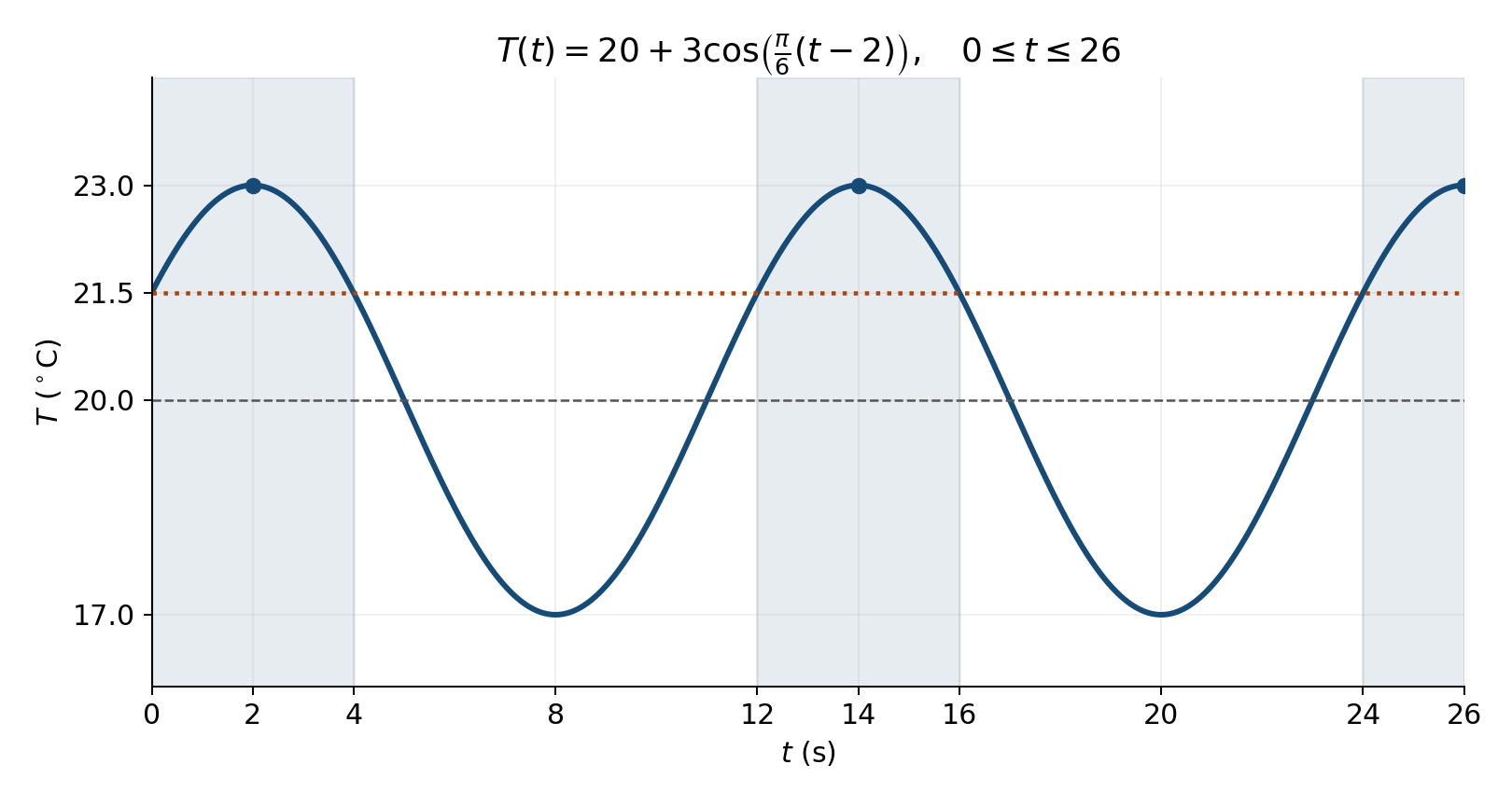
- Read the midline, amplitude, maximum, minimum and period, including the correct units.
- Interpret the phase as a horizontal time shift. Find the first two maximum times in the observation interval. Explain why the number two is not the period.
- Estimate from the graph all times for which . Derive their exact union of closed intervals, not just one inverse-cosine value.
- State what this graph does and does not justify about times outside the observation interval.
Solution · Graphical problem G2
-
The midline is degrees Celsius and the amplitude is degrees Celsius. The maximum is degrees Celsius and the minimum degrees Celsius. They are all attained in the interval. One complete cycle takes
For example, adjacent maxima occur at and . Reading a horizontal distance as an amplitude would confuse seconds with degrees Celsius.
-
Relative to , the graph is shifted two seconds to the right: the cosine argument is zero at . Every maximum occurs when , so for an integer . The first two are two and fourteen seconds, and there is a third at the included endpoint twenty-six seconds. The horizontal shift fixes the starting phase; the separation between repeated peaks fixes the period. Expanding the argument gives phase radians, not a phase of two radians.
-
The threshold is one and a half degrees above the midline. Thus
On the angle axis, cosine is at least one half for angles in . Multiplication by the positive time scale gives
Intersecting this full periodic family with yields
The boundary times zero, four, twelve, sixteen and twenty-four give exactly degrees Celsius; twenty-six gives degrees Celsius. All listed endpoints therefore satisfy the non-strict comparison and the closed observation domain. One principal inverse-cosine output would fail to recover both sides of each peak and the later cycles.
-
The formula has a mathematical periodic extension, but the problem assumes scientific validity only for the stated observation interval. The graph does not prove that an actual apparatus remains periodic or follows this calibration before zero or after twenty-six seconds. An extrapolation would be an additional modelling assumption, not a consequence of a curve drawn within the window.
Summary
Radians connect arc length with angular coordinates. Trigonometric inverses require restricted branches, while trigonometric equations can have many periodic solutions. Amplitude and phase identify the structure of a periodic model. Vector components retain direction, dot products identify perpendicular parts, and matrix notation organizes simultaneous balances.