Apply safe power and logarithm laws to equations, inequalities, integer error thresholds and multiplicative scales.
Course contents
Motivation
Chapter 1 introduced positive-base exponentials, inverse logarithms and a decay model. This chapter develops the underlying algebra beyond that introductory model. You should be able to distinguish integer, rational and real powers; state safe hypotheses for power and logarithm laws; solve elementary exponential and logarithmic equations and inequalities; and turn a repeated-factor error requirement into an integer threshold.
The main discipline is to keep the number system and domain visible. A law valid for positive bases and arbitrary real exponents need not remain valid for negative bases. A logarithmic simplification must not create a logarithm of a nonpositive number.
9.1 Integer powers and the zero cases
For a positive integer n, define an as n repeated factors of a real number a. For a=0, set a0=1 and a−n=1/an. Integer exponent laws follow by grouping and cancelling factors:
am+n=aman,(am)n=amn.
For a nonzero real a these hold for all integer m,n. Also, for real a,b=0 and integer n, (ab)n=anbn and (a/b)n=an/bn. Nonzero assumptions can be weakened when all exponents are positive, but they must be restored whenever a negative exponent or a quotient requires them.
For zero, 0n=0 when n is a positive integer. Negative powers of zero are undefined, because they require division by zero. We leave the expression 00 undefined in this chapter. A polynomial's constant term is a prescribed constant; writing it as the zeroth term in a finite geometric sum does not require a general assignment to the indeterminate expression 00.
Worked example
Worked example 1: organize before evaluating. Since the base two is nonzero,
242−325=2−3+5−4=2−2=41.
For a signed base, parentheses matter: (−2)4=16, while −24=−(24)=−16. The minus sign in the latter expression is not part of the exponentiated base.
9.2 Rational and real powers: when positivity matters
For a>0 and integers p,q with q>0, define ap/q as the unique positive qth root of ap. The definition agrees for equivalent fractions. In particular a1/q is positive, even when q is even: the notation denotes the nonnegative-root function, not both solutions of an equation.
For a negative base, a real qth root exists when q is odd. In this elementary setting, interpret a rational exponent p/q in lowest terms with q>0: if q is odd, define ap/q=(qa)p; if q is even, the expression is not a real number. This convention does not extend a negative base to arbitrary irrational powers as a real-valued function.
Worked example
Worked example 2: roots and solution sets. We have 161/2=4, not ±4. The equation x2=16 has two solutions, x=±4. Also
(−8)1/3=−2,(−8)2/3=4.
But (−8)1/2 is not a real number. Chapter 8 can solve the corresponding complex root equation; it does not justify treating every real-exponent law for negative bases as valid.
Proposition
For a positive real base a, the real power ax is defined for every real exponent x. We use the usual real exponential extension, consistent with rational powers, and the laws
ax+y=axay,(ax)y=axy,(ab)x=axbx(a,b>0).
The shared construction immediately below proves these laws, continuity, strict monotonicity for a=1, and the positive range. It constructs exponentiation before defining inverse logarithms; the formula ax=exp(xlna) is then a consequence, not a circular premise.
Shared foundation: positive real powers without logarithmic circularity
Foundation contract. We take the real numbers as a complete ordered field and use induction on nonnegative integers. Finite algebra, absolute value and the definition of a sequence limit are the basic language. No logarithm, real exponential, derivative, integral or complex power law is assumed in this construction. Negative-base irrational powers are not being defined. The usual constant e>1 may be chosen as a base after the construction; no differential characterization of e is needed for the algebra here.
1. Integer bounds, rational approximation and positive roots. The positive integers are unbounded: if their supremum were s, some integer would exceed s−1, and its successor would exceed s. Thus the Archimedean property holds. For every real x an integer floor exists, since sufficiently large positive and negative integers bound x and the finite intervening integer list has a largest member not exceeding x. Consequently rn=⌊nx⌋/n satisfies rn≤x<rn+1/n. Between distinct reals u<v, choose n with 1/n<v−u; then (⌊nu⌋+1)/n lies strictly between them. These facts use completeness and integer order, not exponentials.
In the complete ordered real field, for b>0 and integer m≥1, let S={t≥0:tm≤b}. It contains min{1,b}>0 and is bounded above by max{1,b}, so r=supS>0 exists. Finite factorization gives, for nonnegative t,r≤M,
tm−rm=(t−r)j=0∑m−1tm−1−jrj,∣tm−rm∣≤mMm−1∣t−r∣.
Take M=r+1. If rm<b, choose 0<h<1 so mMm−1h<b−rm; then (r+h)m<b, contradicting the upper bound r. If rm>b, choose 0<h<min{1,r} with mMm−1h<rm−b. Then (r−h)m>b, and monotonicity of integer powers on nonnegative numbers makes r−h an upper bound of S, contradicting its supremum. Hence rm=b. At b=0 the unique nonnegative root is zero. The same factorization shows tm>sm whenever t>s≥0, so this positive root is unique.
2. Rational powers and their laws. For a>0, define ap/q by the positive qth root of ap, where p∈Z, q≥1 and negative integer powers use reciprocals. If p/q=p′/q′, raising the two positive candidate values to qq′ gives the same value apq′=ap′q; uniqueness of a positive root proves independence of the fraction. To add rational exponents, put them over a common positive denominator and write all powers as integer powers of its unique positive root. The integer grouping laws then give ar+s=aras and a−r=1/ar for rational r,s. Positive-root uniqueness applied to integer products likewise gives (ab)r=arbr for a,b>0 and rational r: if r=p/q, the positive number arbr has qth power apbp=(ab)p and is therefore the defining positive root.
For a>1, a positive rational power is greater than one, so ar is strictly increasing in rational r. Induction proves Bernoulli's inequality (1+d)n≥1+nd for d≥0: multiplication by 1+d adds the nonnegative term nd2 to the next step. With d=a1/n−1≥0 it yields
1≤a1/n≤1+na−1.
Thus a1/n→1, and for rational ∣h∣≤1/n, a−1/n≤ah≤a1/n.
3. Supremum extension and the addition law. For a>1 and real x, define
Ea(x)=sup{ar:r∈Q,r≤x}.
Choose integers M≤x<N. Then aM belongs to the set and aN is an upper bound. The supremum therefore exists and is at least aM>0; this does not assert a positive lower bound for every member of the defining set. For rational x it equals the rational power ax. With rn=⌊nx⌋/n and vn=a1/n, monotonicity on rational exponents gives
arn≤Ea(x)≤arnvn.
An integer N>x bounds arn≤aN, so 0≤Ea(x)−arn≤aN(vn−1)→0. Hence arn→Ea(x). For real x,y, put tn=rn(x)+rn(y). Then tn≤x+y<tn+2/n, and
atn≤Ea(x+y)≤atnvn2.
The rational addition law gives atn=arn(x)arn(y)→Ea(x)Ea(y), and the factors atn are bounded above by one fixed integer power. Since vn2→1, the displayed bound proves Ea(x+y)=Ea(x)Ea(y). The elementary product-limit step is justified directly by
∣unvn−uv∣≤∣un∣∣vn−v∣+∣v∣∣un−u∣,
because a convergent un satisfies ∣un∣≤∣u∣+1 on a tail. Choose ∣vn−v∣<ε/[2(∣u∣+1)] and ∣un−u∣<ε/[2(∣v∣+1)] on a common tail; the right side is then smaller than ε. The squeeze steps follow by making their explicit nonnegative upper bounds smaller than ε.
The defining sets show that Ea is nondecreasing, Ea(0)=1, and the addition law gives Ea(−x)=1/Ea(x). If h>0, choose a rational 0<r<h; then Ea(h)≥ar>1. Therefore x<y implies Ea(y)=Ea(x)Ea(y−x)>Ea(x): the extension is strictly increasing.
4. Continuity and every positive output. If ∣h∣≤1/n, then
a−1/n≤Ea(h)≤a1/n.
Both bounds approach one; for vn=a1/n≥1, 0≤1−vn−1≤vn−1→0. Given any tolerance, choose n so the bounds differ from one by less than that tolerance, then take ∣h∣<1/n. This proves continuity at zero. The addition law Ea(x+h)=Ea(x)Ea(h) proves continuity at every x, with the tolerance divided by the fixed positive factor Ea(x).
Bernoulli gives Ea(n)=an≥1+n(a−1), which is unbounded; Ea(−n)=1/an→0. Fix u>0. The real set T={t:Ea(t)≤u} is therefore nonempty and bounded above. Let x=supT. If Ea(x)<u, continuity gives a small h>0 with Ea(x+h)<u, contradicting the upper bound x. If Ea(x)>u, continuity gives a small h>0 with Ea(x−h)>u; monotonicity then makes x−h an upper bound of T, contradicting the least upper bound. Thus Ea(x)=u. Strict monotonicity makes this preimage unique. We have constructed a continuous bijection R→(0,∞) without logarithms.
5. All positive bases and the remaining real-exponent laws. Set 1x=1. For 0<a<1 define ax=E1/a(−x); for a>1 write ax=Ea(x). These definitions agree with rational powers, preserve the addition law and continuity, and give strict decrease and the same positive range when 0<a<1.
For a,b>0, choose rationals rn→x. Continuity in the exponent and the rational law (ab)rn=arnbrn give (ab)x=axbx. For the power-of-a-power law, first let r=p/q be rational with q>0. The addition law proves (ax/q)q=ax, so positive-root uniqueness gives (ax)1/q=ax/q. Integer powers and reciprocals now give (ax)p/q=axp/q. Finally take rationals rn→y and use continuity of both exponent functions in (ax)rn=axrn to obtain (ax)y=axy. Every base used in these root and continuity steps is positive.
6. Inverse logarithms, with no cycle. For a>0, a=1, define loga to be the inverse of the bijection just proved. A strictly increasing function has a strictly increasing inverse; a strictly decreasing one has a strictly decreasing inverse, since the two possible input orders give the corresponding strict output orders. This proves the monotonicity used in logarithmic inequalities. The product, quotient, power and change-of-base logarithm proofs in this chapter now rest on the independently constructed exponent laws and inverse identities. If exp(x)=ex and ln=loge, then a=elna and the now proved power law gives ax=exp(xlna) as a consequence, not a circular definition used to justify those same laws.
Common mistake
Do not transplant the middle law to an arbitrary negative base. With a=−1, x=2, y=1/2, the expressions are both real, but
[(−1)2]1/2=1whereas(−1)2(1/2)=−1.
Thus even having defined individual expressions does not make the unrestricted law true. Similarly x2=∣x∣ for real x, not x in general.
9.3 Logarithms and their laws with proofs
Definition
For a>0, a=1, the function x↦ax maps R bijectively onto (0,∞). Its inverse is loga. Therefore
logau=v⟺av=u(u>0).
The base must be positive and not one, and the argument must be positive. In particular, loga1=0 and logaa=1. There is no real loga0; the fact that positive arguments may approach zero is not an assignment of a real logarithm at zero.
To prove the product law, write s=logau, t=logav. Then u=as, v=at, so uv=as+t. Applying the inverse gives the result. The quotient proof uses u/v=as−t. The power proof uses up=(as)p=asp, permitted because the base is positive. These are consequences of exponent laws and invertibility, not independent symbolic tricks.
Worked example
Worked example 3: a safe expansion. If x>0 and y>0,
ln(3x2y)=2lnx+21lny−ln3.
If x<0 and y>0, the original argument is still positive, but the written term lnx is undefined. A valid formula for all x=0, y>0 is instead
ln(3x2y)=2ln∣x∣+21lny−ln3.
An expansion may require more restrictions than the original expression if absolute values or case distinctions are omitted.
There is no logarithm law turning a sum into a sum of logarithms. For example, ln(1+1)=ln2>0, while ln1+ln1=0. The product law applies to multiplication, not to addition.
For another permitted base b>0, b=1, change of base gives
logau=logbalogbu(u>0).
To prove it, set v=logau, so u=av. Taking logb gives logbu=vlogba. The denominator is nonzero because a=1. Choosing b=e gives logau=lnu/lna.
9.4 Monotonicity governs inequalities
If a>1, ax and logax are strictly increasing. If 0<a<1, both are strictly decreasing. The second case can be seen from ax=(1/a)−x, where 1/a>1, and then from inversion.
Consequently, for positive u,v,
logau≤logav⟺{u≤v,u≥v,a>1,0<a<1.
The reversal is essential. The argument positivity conditions remain in force even when the logarithm disappears from the final inequality.
Worked example
Worked example 4: a logarithm with base below one. Solve
log1/2(x−1)≥−2.
First, x>1. Because the logarithm is decreasing, comparison with log1/24=−2 gives x−1≤4. Combining with the domain yields
1<x≤5.
At x=5 equality holds; at x=1 the logarithm is undefined. Forgetting the base reversal would select the wrong side of the endpoint.
A logarithm is positive when its argument is above one for bases greater than one; for bases below one the positive-logarithm arguments lie between zero and one. A negative logarithm is an ordinary real output, not an indication that its argument was negative.
9.5 Solving equations without inventing solutions
Worked example
Worked example 5: a logarithmic equation. Solve
log2(x−1)+log2(x+1)=3.
Both arguments must be positive, so x>1. On that domain the product law and invertibility give
log2[(x−1)(x+1)]=3⟺x2−1=8⟺x=3 or x=−3.
Only x=3 lies in the original domain. Substitution gives log22+log24=1+2=3. The other algebraic root is not a solution of the original equation. A positive product alone would not guarantee that its two factors were individually positive.
Worked example
Worked example 6: use a positive substitution. Solve 4x−5⋅2x+4=0 for real x. Let u=2x>0. Then 4x=(2x)2=u2, so
u2−5u+4=(u−1)(u−4)=0.
Both roots are positive. The equations 2x=1 and 2x=4 give x=0 and x=2. Each checks. If the quadratic had produced a nonpositive u, it would have to be rejected before taking its logarithm.
Worked example
Worked example 7: a variable base. Solve logx9=2. Before any conversion, the base conditions are x>0 and x=1. The inverse relation gives x2=9, with candidates x=3 and x=−3. Only three is a valid logarithmic base. Hence the unique solution is x=3.
The notation logau has two mathematically different inputs: the base and the argument. If either contains a variable, its restrictions need to be recorded. In a scientific formula, unknown signs cannot be decided by what looks convenient for a logarithm.
9.6 Integer thresholds in geometric error estimates
Suppose C>0, 0<q<1 and an error after integer N≥0 is EN=CqN. For a tolerance ε>0, taking natural logarithms gives
EN≤ε⟺Nlnq≤ln(ε/C)⟺N≥lnqln(ε/C),
because lnq<0. Thus the smallest allowed integer is
Nmin=max{0,⌈lnqln(ε/C)⌉}.
The ceiling ⌈t⌉ is the least integer at least t. For a strict error requirement EN<ε, the inequality for N is strict, so the formula becomes
Nmin=max{0,⌊lnqln(ε/C)⌋+1}.
Here ⌊t⌋ is the greatest integer at most t. These formulas include a tolerance already met at N=0. If the application permits only N≥1, replace the outside zero by one. If C=0, every error is zero and logarithmic division by C should not be attempted; handle that case directly.
Worked example
Worked example 8: compare the neighboring integers. Let EN=5(0.7)N and require EN≤0.02. The logarithmic threshold is approximately 15.4804, so the candidate integer is 16. Check the exact neighboring powers rather than trusting a rounded threshold:
5(0.7)15≈0.0237378>0.02,5(0.7)16≈0.0166165<0.02.
Because the errors decrease with N, this proves the smallest permitted integer is 16. When a calculated threshold is close to an integer, rounding prematurely could give the wrong choice.
9.7 Power laws and dimensionless logarithmic scales
A positive-input power law may be written in dimensionally clear form as
y0y=(x0x)p,x,x0,y,y0>0.
Taking logarithms gives
ln(y/y0)=pln(x/x0).
The arguments are dimensionless ratios, so the equation is independent of the measurement units. On axes recording these logarithmic ratios, the model is a straight line through the origin with slope p. A data pattern that is approximately straight on such axes is evidence for a candidate power law, not proof of an exact physical law beyond the observed range.
Worked example
Worked example 9: recover an exponent from a ratio. In a model, doubling x triples y. Then 3=2p, so
p=ln2ln3.
The exponent is not three: a power-law exponent records the logarithmic ratio of changes. Once this idealized exponent is chosen, multiplying x by four multiplies y by 4p=(2p)2=9.
A logarithmic score can instead be defined by D=10log10(Q/Q0) for positive Q,Q0. Increasing D by ten multiplies Q/Q0 by ten; increasing it by three multiplies the ratio by 100.3, not by three. This statement follows from the definition without assuming a particular physical application. A logarithmic display compresses multiplicative ranges but does not turn additive changes in the original quantity into equal steps.
9.8 Graded exercises
Foundation
Checkpoint
Exercise 1
Evaluate 3−2, (−3)2, −32, 163/4 and (−32)2/5 as real numbers.
Checkpoint
Exercise 2
List which of 0−2, 03, (−4)1/2 and (−27)1/3 are defined as real numbers under this chapter's conventions.
Checkpoint
Exercise 3
Evaluate log327, log1/28 and log51.
Checkpoint
Exercise 4
Give a checked counterexample to loga(u+v)=logau+logav, using one valid base and positive arguments.
Core
Checkpoint
Exercise 5
State the real domain of ln[(x−2)/(x+1)] and compare it with the domain of ln(x−2)−ln(x+1). Where is their equality valid?
Checkpoint
Exercise 6
Solve lnx+ln(x+3)=ln10 over the reals.
Checkpoint
Exercise 7
Solve 9x−10⋅3x+9=0 over the reals.
Checkpoint
Exercise 8
Solve log3(x+1)≤2.
Checkpoint
Exercise 9
Solve log1/2(2x+1)>1.
Checkpoint
Exercise 10
Solve logx16=4, stating the base restrictions first.
Checkpoint
Exercise 11
Prove ln(x2)=2ln∣x∣ for every real x=0. Explain why 2lnx is not an equivalent real expression on the entire domain.
Checkpoint
Exercise 12
An error is EN=8(1/2)N for integers N≥0. Find the smallest N for (a) EN≤1/8 and (b) EN<1/8.
Synthesis
Checkpoint
Exercise 13
In a positive-input power-law model, tripling x multiplies y by five. Find the exponent and the multiplier for multiplying x by nine. State the positivity needed for taking logarithms.
Checkpoint
Exercise 14
For the defined score D=10log10(Q/Q0), find Q/Q0 at D=−20, and find the multiplicative change in Q when D rises from −20 to −5 with fixed Q0.
Checkpoint
Exercise 15
A student claims (−1)2(1/2)=[(−1)2]1/2 by the power-of-a-power law. Evaluate each side and identify the missing hypothesis.
Checkpoint
Exercise 16
Suppose C>0, 0<q<1 and N is a nonnegative integer. Derive the least N satisfying CqN≤C. Then derive the least N satisfying CqN<C. Compare with the ceiling and floor formulas rather than assuming the two tolerances behave the same.
9.9 Full solutions
Solution · Exercise 1
The values are 1/9, 9, −9, (161/4)3=23=8, and [(−32)1/5]2=(−2)2=4.
Solution · Exercise 2
The first is undefined because it requires division by zero. The second is defined and equals zero. The third has no real value because a real square cannot be negative. The fourth is defined and equals −3.
Solution · Exercise 3
They are three, minus three and zero respectively: 33=27, (1/2)−3=8, and 50=1.
Solution · Exercise 4
Use base two and u=v=1. The left side is log22=1, while the proposed right side is 0+0=0. All logarithms in this counterexample are defined.
Solution · Exercise 5
For the first expression, require (x−2)/(x+1)>0 and x=−1. A sign chart gives x<−1 or x>2. The expanded expression requires x−2>0 and x+1>0, hence only x>2. The quotient law proves equality there. For x<−1, the original positive ratio has a real logarithm but the individual logarithms are undefined, so the expansion cannot represent it. An alternative expression on the full original domain is ln∣x−2∣−ln∣x+1∣.
Solution · Exercise 6
The domain requires x>0. Combine logarithms to get x(x+3)=10, or (x+5)(x−2)=0. The candidate −5 is inadmissible; x=2 gives ln2+ln5=ln10. Thus two is the only solution.
Solution · Exercise 7
Set u=3x>0, giving u2−10u+9=(u−1)(u−9)=0. Both roots are positive. Thus x=0 or x=2, and each satisfies the original equation.
Solution · Exercise 8
The domain is x>−1. The base three is greater than one, so the inequality is equivalent to x+1≤9. Therefore −1<x≤8.
Solution · Exercise 9
Require 2x+1>0, so x>−1/2. Because the base is below one, comparison with log1/2(1/2)=1 gives 2x+1<1/2, or x<−1/4. Combine to obtain (−1/2,−1/4), with both endpoints excluded.
Solution · Exercise 10
Require x>0, x=1. The equation gives x4=16. Its real candidates are two and minus two, of which only two is a permitted base. Hence x=2.
Solution · Exercise 11
Since x=0, ∣x∣>0 and x2=∣x∣2. The positive-argument power law gives ln(x2)=ln(∣x∣2)=2ln∣x∣. For negative x, lnx is undefined, whereas the original expression is defined; for example x=−1 gives ln1=0.
Solution · Exercise 12
The condition 8/2N≤1/8 is 2N≥64, so the least integer is six. For strict inequality require 2N>64, so the least integer is seven. At six the error is exactly 1/8, which explains the difference.
Solution · Exercise 13
With positive input and output reference ratios, 5=3p, hence p=ln5/ln3. Multiplying x by nine multiplies y by 9p=(3p)2=25. Positive ratios ensure the real logarithms are defined; the reference ratio of input is three, not one, so the denominator logarithm is nonzero.
Solution · Exercise 14
Rearranging gives Q/Q0=10D/10. At D=−20, the ratio is 10−2=1/100. The score increase is fifteen, so the multiplier is 1015/10=103/2=1010. A negative score corresponds to a positive ratio below one, not a negative quantity.
Solution · Exercise 15
The left side is (−1)1=−1, while the right is 11/2=1. The real-exponent power-of-a-power law was stated for positive bases; the original base is negative. Each expression having an individual real meaning is not sufficient to extend the law.
Solution · Exercise 16
Divide by C>0. For qN≤1, N=0 already gives equality, so the least N is zero. For qN<1, zero fails and one works because q<1, so the least N is one. In the general formulas ε/C=1 makes the logarithmic threshold zero. The non-strict formula gives max{0,⌈0⌉}=0, and the strict formula gives max{0,⌊0⌋+1}=1, as required.
Graphical workshop G4
Checkpoint
Graphical problem G4
Straight on which axes?
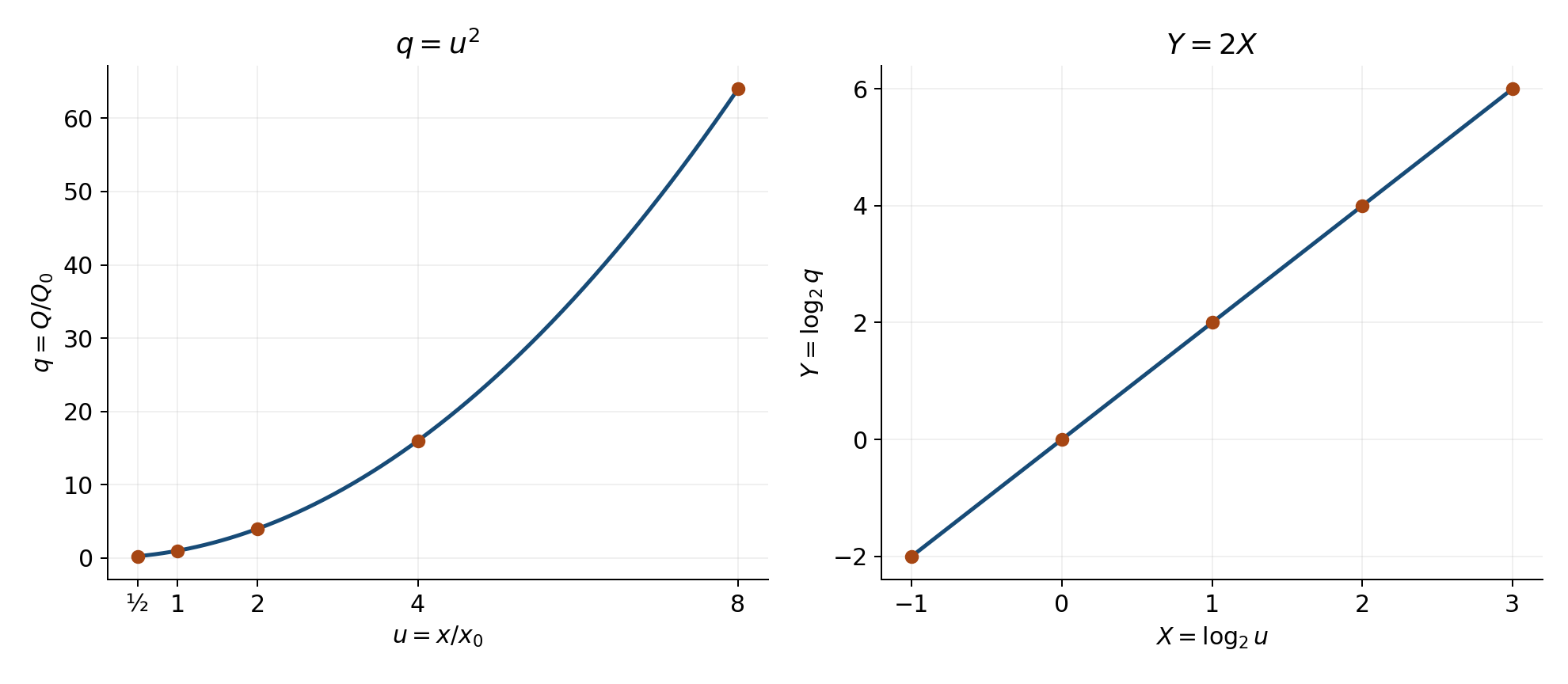
A calibration exercise constructs the following exact positive dimensionless ratios. They are illustrative exercise data, not external experimental measurements. Let u=x/x0 and q=Q/Q0, where x,x0,Q,Q0>0 and each numerator has the same physical units as its own reference denominator.
Input ratio u
1/2
1
2
4
8
Output ratio q
1/4
1
4
16
64
The left plot shows ordinary ratio coordinates. The right plot shows the coordinates X=log2u and Y=log2q. The candidate curves are shown only over the data's input interval [1/2,8].
Transform all five pairs and use two points on the right graph to find its slope. Under the assumed power-law modelq=up, determine p and recover the equation in ordinary ratio coordinates.
Explain what one horizontal unit on the right plot means for the original input. If an input is tripled within the model's validity range, by what factor does its output change?
Why can neither a zero nor a negative input/output ratio be placed on the logarithmic plot? Do negative values of X or Y represent negative physical ratios?
Do five collinear transformed points prove that the power law holds at every positive input, or that the ordinary-coordinate graph is a straight line? Distinguish graphical evidence, an assumed model and a universal conclusion.
Solution · Graphical problem G4
The transformed pairs are
(−1,−2),(0,0),(1,2),(2,4),(3,6).
For instance the slope through (0,0) and (3,6) is 6/3=2. If q=up with u>0, taking base-two logarithms gives Y=pX. The power-law model therefore requires p=2, so q=u2. Substitution checks all five original pairs. In physical variables this candidate is Q/Q0=(x/x0)2, or Q=Q0(x/x0)2. The references retain the model's units; logarithms were taken of ratios, not dimensioned concentrations or times.
Increasing X by one multiplies u by two, because u=2X. Equal horizontal distances on the transformed graph correspond to equal multiplicative factors, not equal additive increases in the original input. With exponent two, replacing u by 3u gives (3u)2/u2=9, so the output is multiplied by nine. If this is an empirical candidate model, both the original and tripled input must remain within whatever validity range is actually established.
Real logarithms require positive arguments, so u=0, q=0 and negative ratios have no plotted logarithmic coordinates. In contrast, X=−1 means u=2−1=1/2>0, and Y=−2 means q=2−2=1/4>0. A negative logarithmic coordinate indicates a positive ratio below one, not a negative physical quantity. The apparent intercept (X,Y)=(0,0) corresponds to (u,q)=(1,1), not to a zero input or zero output.
All five readings are consistent with this power-law hypothesis, and the given formula proves the line for every positive input within that mathematical model. The finite dataset alone cannot establish a physical law between or beyond its readings. Other functions can agree at all five inputs and differ elsewhere. Furthermore, a straight line in transformed coordinates is not a straight line in the original coordinates: q=u2 has changing secant slopes there. Graphical appearance depends on the stated axes and scale. Extrapolating the model beyond the displayed interval needs independent scientific justification.
Summary
Integer powers are repeated multiplication and reciprocals. Rational powers require root and sign conventions; arbitrary real-exponent laws are safe with positive bases. Real logarithms require a positive base different from one and a positive argument. Their laws follow from exponentiation and inversion. The base determines whether a logarithmic inequality preserves or reverses order. Domains survive transformations, and exponential substitutions carry positivity restrictions. Logarithms turn a geometric error inequality into an integer threshold, but strict tolerances and rounding still need attention. Dimensionless ratios make logarithmic scientific models interpretable across units.
Connections. This chapter completes the exponentiation/logarithm algebra beyond Chapter 1's introductory inverse models. Chapter 5 supplies finite products and repeated changes; Chapter 6 supplies geometric remainders; Chapter 7 supplies sign-aware proof habits. Complex powers in Chapter 8 use a different number system and do not silently extend every real power convention here.
 Evanalysis