
Separate a coordinate pair from the point it represents
With nonnegative radius, polar coordinates use the map
Angles are in radians. At , adding an integer multiple of to the angle leaves the represented point unchanged. At , every angle represents the origin. This describes the coordinate map; a particular polar equation can impose further restrictions on which pairs are solutions.
If is the set of allowed coordinate pairs satisfying an equation, its planar locus is . Membership in this image means that at least one allowed pair represents the point. It does not require every representation of that point to satisfy the equation. A later restriction to changes the allowed pair domain and must be applied before listing its angle solutions.
Prove the point set in both directions
Replacing by and by proves a rectangular consequence of the polar equation. To prove equality of loci, one must also start with a rectangular point and find an allowed polar pair satisfying the original equation. For a nonzero point choose ; division by is then legitimate. At the origin division is unavailable, so check a permitted angle separately.
This is a question about logical reversibility, not the appearance of the graph. Equal axis scales let the diagram support the geometric interpretation of centre and radius; the two inclusions establish the exact point set. The following four questions keep these two tasks distinct.
Read the circle and answer the four questions
Checkpoint
Graphical practice G3: polar pairs, a circle and the origin
Let be numerical lengths measured in centimetres, and let be in radians. Use nonnegative polar radii and
Consider the polar equation
The figure uses equal scales on the two rectangular axes. The ray through has direction .
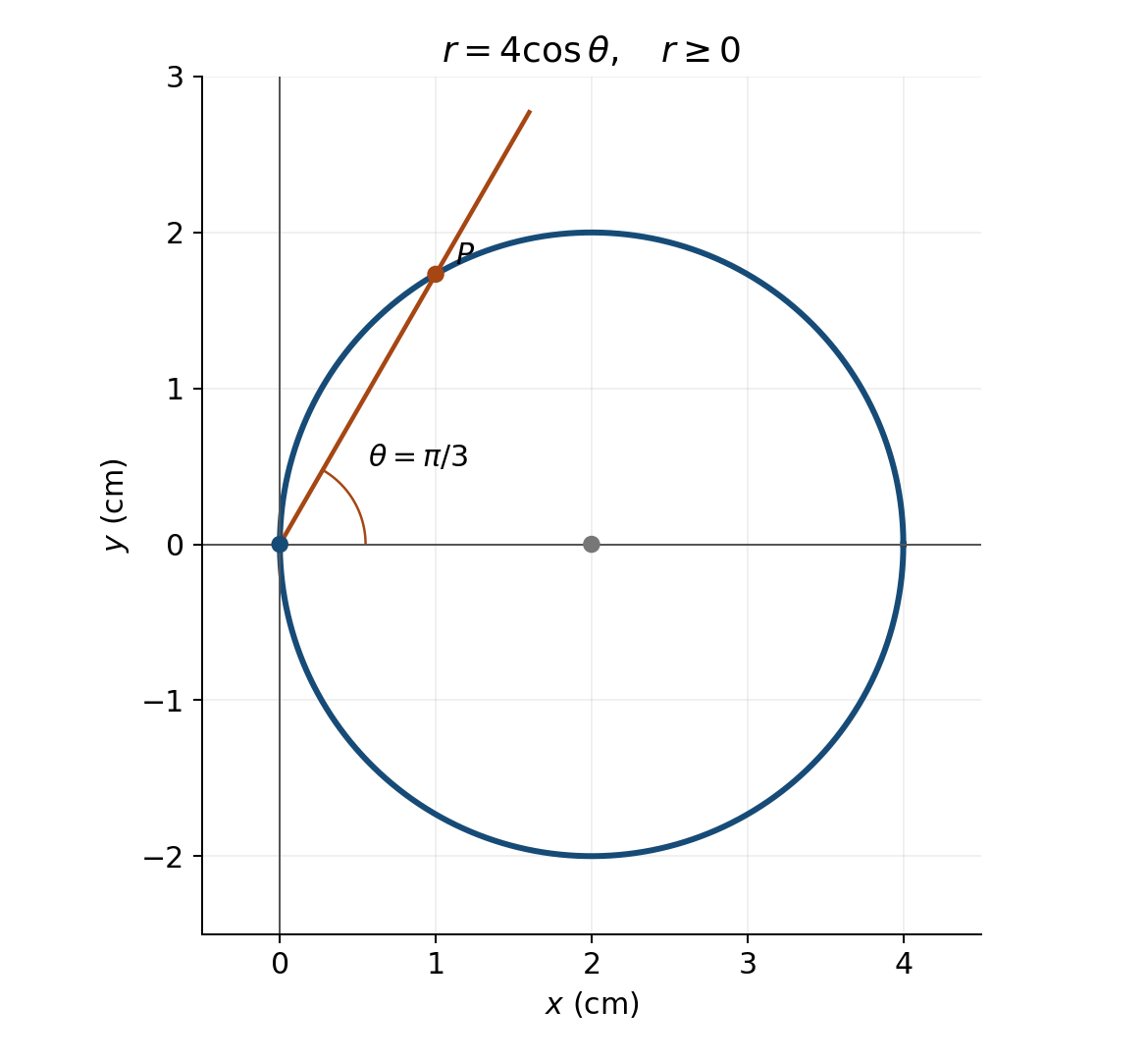
- Convert the polar equation to a rectangular equation. Verify the centre and radius read from the graph. Prove the converse and check the origin separately, so that the full point set is established.
- When , which angles permit ? Which angles represent the origin while satisfying the polar equation?
- Find and the rectangular coordinates of exactly. A whole ray intersects the rectangular circle at the origin as well as at . Does the pair satisfy the original polar equation? Explain the distinction.
- A student cancels in . Does this preserve all polar-coordinate pairs? Does it preserve the rectangular point set in this example?
Complete solutions: pairs, points and the zero branch
Solution · Graphical practice G3: polar pairs, a circle and the origin
-
Multiplying by gives , hence
The centre is centimetres and the radius is two centimetres, matching the undistorted circle in the figure. Multiplication alone proves only one implication. Conversely, take a nonzero point satisfying the rectangular equation, choose its nonnegative radius and a corresponding angle. Then , and division by this positive radius recovers . The origin also belongs to the polar locus: , satisfies the equation. Thus no rectangular point was lost or added.
-
For a strictly positive radius, , so within the stated angle window we require . The origin has and the equation then requires , giving or in this window. Each pair describes the same origin. Negative cosine values would require negative radii and are not allowed under this convention. Letting vary from to traces the full circle, with the origin represented at both ends.
-
At , . Thus
Its squared displacement from the centre is , as required. But does not satisfy , since it would assert . A rectangular point can have several polar representations; membership of a point in a locus means that at least one permitted representation satisfies its equation, not that every representation does. The origin lies on the ray and circle as a rectangular point, while the polar equation represents it at different angles.
-
The multiplied equation holds at for every angle, whereas the cancelled equation holds there only when . Cancelling therefore removes many polar-coordinate pairs and is not reversible on the full pair domain. Nevertheless, in this example every removed pair represents the same origin, and the origin is still represented by a surviving pair. At positive radius the division is reversible. The two equations thus have the same rectangular point set even though their polar-pair solution sets differ.
When cancellation changes pairs but preserves points
In this example, multiplying by adds all pairs with that were not already solutions. Every added pair maps to the origin, and that point already has an original solution pair, such as . Hence the image point set is unchanged even though the pair set grows. This conclusion depends on checking the zero-radius branch.
It is not a general license to multiply or divide polar equations without checking. For example, with describes the unit circle; multiplying by gives and adds the origin to the planar locus. In either direction, record which pairs are lost or added and then examine their images under .