This note starts chapter 5 by slowing down and making the first limit definition fully explicit. Before talking about limits of functions, first study limits of sequences. That is the right order: a sequence moves along the number line in discrete steps, so it is the cleanest place to learn how a formal limit definition works.
A sequence is a function, not just a pattern
Many students first meet sequences as lists such as
or
The familiar idea must be reinterpreted in a more precise way.
Definition
Sequence in a set
Let be a set. A sequence in is a function
If the image of is written , then the sequence is denoted .
So a sequence is not required to come from a simple formula. The only formal requirement is that each natural number is assigned an element of the target set.
Definition
Rational and real sequences
A sequence of rational numbers is a map . A sequence of real numbers is a map .
This functional viewpoint matters later. It reminds you that a sequence has a domain, a codomain, and an indexing variable. The dots are only informal shorthand.
Why limits of sequences come before limits of functions
For a sequence, approaching the limit means going further and further out in the index . There is only one direction to move: toward larger natural numbers.
That is much simpler than the function-limit situation, where can approach a point from the left and the right and through infinitely many real values in between.
So chapter 5 begins with the discrete version:
- choose a candidate limit ,
- choose an error tolerance ,
- ask whether the terms eventually stay inside the band of radius around .
The formal definition
Definition
Limit of a real sequence
A sequence of real numbers has limit if for every positive real number , there exists such that for all ,
In that case we write
or say that converges to .
The quantifiers make the order of choices explicit:
How to read the quantifiers correctly
The definition is easier once you separate its jobs.
- : you do not get to choose only one error bar. The sequence must eventually fit inside every positive tolerance band.
- : after seeing the chosen , you are allowed to pick a tail-starting point .
- : once you pass that point, every later term must stay inside the band.
So convergence is an eventual-tail statement. The first few terms may behave badly. That does not matter. What matters is the behavior far enough out in the sequence.
Common mistake
N may depend on epsilon, but not on n
When proving convergence, you are allowed to choose after the tolerance is given. But once is fixed, the inequality must hold for every . You are not allowed to choose a different for each later term.
Common mistake
Convergence is not about early terms
Changing finitely many initial terms of a sequence never changes whether the sequence converges, because the definition only cares about the tail .
The strict inequality in the definition is . If an estimate is proved for , where is an integer with , choosing is safe because implies . If the estimate needs , choose an integer with ; the choice of is made after but before the arbitrary later index.
First worked example:
A basic example is that
has limit . Let us write the proof in full.
Worked example
Proving that
Here , so the reciprocal is defined even if the course convention includes 0 in . Let be given. We want , that is,
This is guaranteed once
So choose a natural number with . Then every satisfies
Therefore
This proof is typical. Start from the quantity you need to make small, simplify it, and then choose large enough.
Second worked example:
A slightly richer example uses a rational-function sequence and proves its limit.
Worked example
Proving that
We compute
For large , the denominator is positive, so
Now pick large enough that whenever . Then
So it is enough to ensure
Choose so large that both and hold for all . Then
Hence
The algebra looks longer, but the logical structure is exactly the same as for : rewrite the error term and make it small by forcing to be large.
Designing an epsilon threshold
The rational example requires two conditions on the same tail: the denominator estimate needs , and the error estimate needs . Given , choose an integer
Then every satisfies both conditions, so . This is the dependency order of the proof: derive the bound, choose one threshold for all restrictions, then verify it for an arbitrary later index.
The index convention also matters. The expression is defined for . To make it a sequence on , specify the value at separately. A finite initial change does not affect convergence.
Worked example
A finite prefix and an identical tail
Let and for . Given , choose an integer with . Then every satisfies ; the exceptional first term lies before the threshold. Thus .
A simple but important special case
For the constant sequence , the limit is immediate.
Worked example
Constant sequences converge to their constant value
Let for all . Then for every ,
for every natural number .
So any natural number can serve as , and
This small example is worth keeping in mind because it shows what the definition looks like when the error term is already zero.
What convergence means geometrically
If , then no matter how narrow a band you draw around , the tail of the sequence eventually stays inside it.
Equivalently:
- you may reject finitely many early terms;
- afterward the sequence cannot keep escaping the chosen -band.
That is why convergence is stronger than “having many terms near ”. The definition requires all sufficiently late terms to be near .
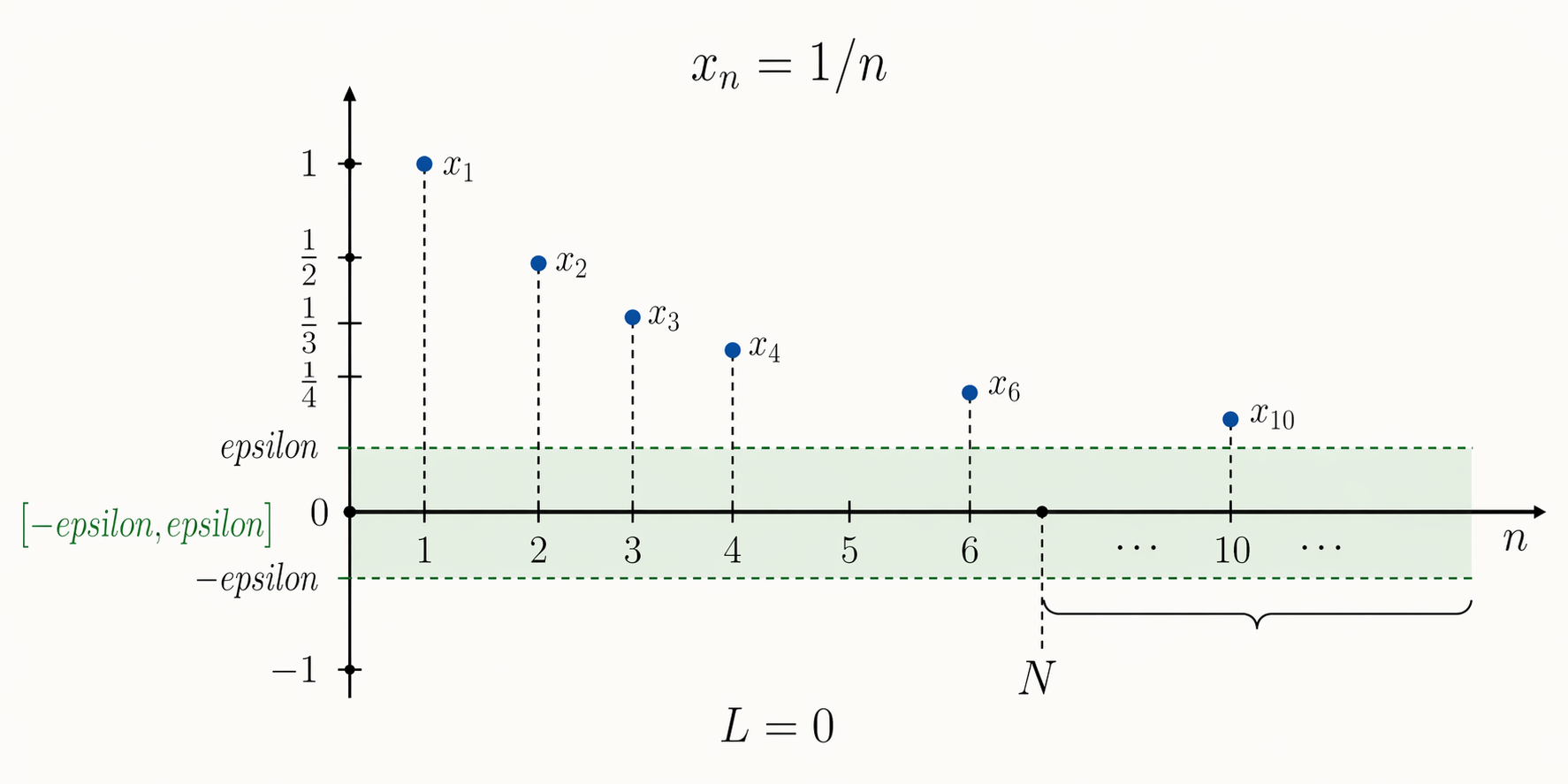
Figure. Convergence means more than seeing some terms near . After a large enough index , the whole tail must remain inside the chosen -band.
Compare tails interactively
In the figure below, choose a sequence and a tolerance , then move to test a proposed tail. The plotted signed errors show which terms lie in the open band . Check the terms with , and compare the figure with the accompanying algebraic explanation: a finite plot illustrates the tail, but the estimate must justify every later term.
Open circles precede the tail; arrows mark errors beyond the plotted scale.
The selected N works. A sufficient threshold is N=5.
.
The plot shows the signed error , so the open band is . Terms with form the selected tail. A finite picture illustrates the condition; the algebraic bound establishes it for every later index. Here the convention is (strictly after ).
Proof tools for sequence limits
The definition controls a tail, so several useful consequences follow by making that tail explicit.
Theorem
Limits are unique
A real sequence cannot converge to two different limits. Suppose that and with . Choose
For sufficiently large , both and . The triangle inequality then gives
which is impossible. Thus the limit, when it exists, is unique.
Theorem
Every convergent sequence is bounded
If , then there are real numbers and such that for every index. Use to choose so that implies . The terms with form a finite set, so they have a minimum and maximum . Taking
bounds both the finite initial segment and the tail.
Theorem
Absolute values preserve limits
If , then . The reverse triangle inequality says
Given , use the same index supplied for . The displayed inequality transfers that estimate directly to the absolute values.
Worked example
Derive both triangle inequalities
The triangle inequality applied to gives
For the reverse triangle inequality, apply the triangle inequality to and then rearrange:
Interchanging and gives ; combining the two inequalities is exactly .
Algebra of sequence limits
Once the basic examples are established, the limit laws let us combine them. Their proofs show why the same threshold must control every error.
Theorem
Sum and product laws for sequences
If and , then and .
Proof. For the sum, make each error smaller than and use the triangle inequality on the common tail. For the product, first use with tolerance to obtain the fixed bound . Put . Given , choose a common tail on which
All bounds now hold for the same arbitrary beyond the threshold, so
The preliminary bound prevents the factor from magnifying a small error without control; using also covers .
Theorem
Reciprocals of nonzero limits
If and , then on the tail where the reciprocal is defined.
Proof. Choose a tail with . Then , and
Given , enlarge the threshold so that also holds. The error is then below , and every division is justified by the earlier lower bound.
Worked example
Apply the sequence laws
For , the sum law gives . The product law then gives by writing the expression as . Both conclusions use the proved limit with its stated domain.
Further examples: comparison, oscillation, and growth
Worked example
Compare two rational-expression limits
For
we have, for ,
because the denominator is at least and . Given , choose an integer . Then implies , so .
Now consider a numerator with an oscillating term:
Subtracting 1 gives
Using , for we obtain
Choose ; then .
Worked example
The sequence has no finite limit
For every , induction gives : it is true at , and . Thus is unbounded. A convergent real sequence is bounded, so the sequence cannot converge to a real number.
Worked example
Rationalize
For ,
Given , choose an integer . Then implies , proving .
Worked example
The discrete limit
For , induction shows . The base case is ; if the inequality holds at , then , so . Consequently,
Given , choose larger than both 4 and . Then gives , hence .
Worked example
Finite changes do not change a sequence limit
If two sequences agree for all and one converges to , choose the limit threshold for a given and enlarge it to exceed . The two tails then have identical terms and the same estimate, so the other sequence also converges to .
Quick checks
Checkpoint
In the definition of , what is the role of N?
Answer in terms of the tail of the sequence.
Solution · Answer
marks the point after which every later term must lie within the chosen -band around . It is a tail-starting index.
Checkpoint
Why does changing the first ten terms of a convergent sequence never destroy convergence?
Look at which indices the definition actually controls.
Solution · Answer
Because convergence only asks for a property of all terms with for some large . Changing finitely many initial terms does not change the eventual tail behavior.
Exercises
Checkpoint
Write the sequence-limit definition entirely in symbols.
Do not omit the order of the quantifiers.
Solution · Guided solution
The symbolic form is
The order matters: first the tolerance is chosen, then , then every later term is checked.
Checkpoint
Show directly from the definition that .
Compare it with the proof for .
Solution · Guided solution
Let . We want
This is true once . Choose a natural number with . Then every satisfies , so .
Checkpoint
Why is it not enough for infinitely many terms of a sequence to lie close to L?
Contrast “infinitely many” with “all sufficiently late”.
Solution · Guided solution
Because convergence requires the whole tail to stay close to , not merely a subcollection of terms. A sequence can visit points near infinitely often and still keep escaping far away at later indices.
Prerequisites and continuation
Read this after 4.6 Decimal expansions and irrational numbers and 4.3 Completeness and gaps in Q. Then continue to 5.2 Cauchy sequences and another model of the reals.